
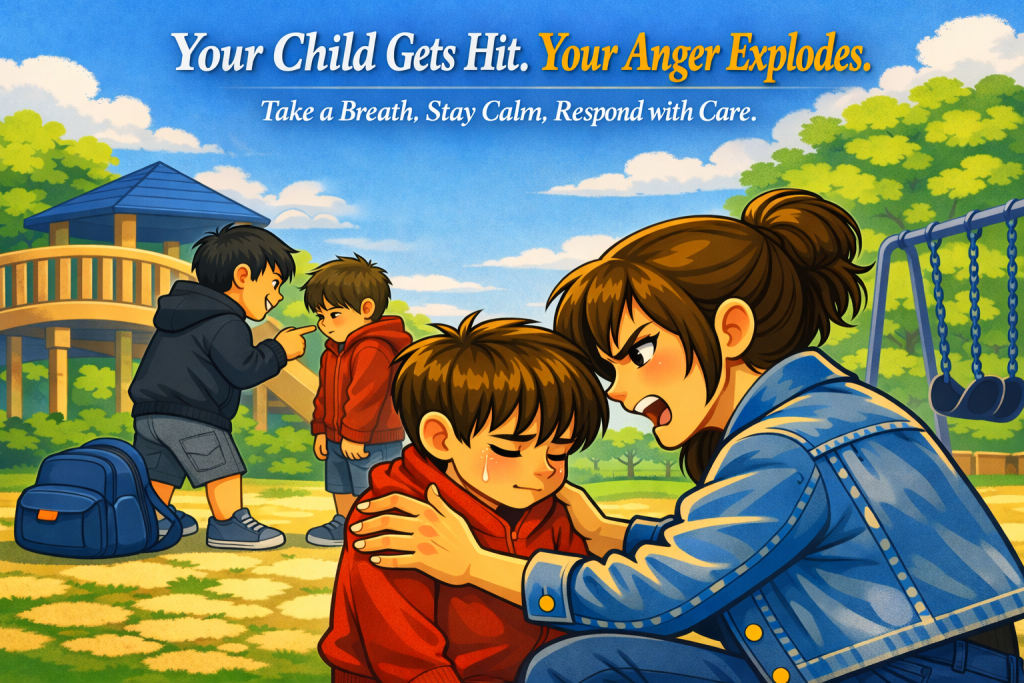
Picture this: you’re enjoying a perfectly pleasant day with your kid. Maybe you’re at a public children’s event, maybe it’s a friend’s birthday party — everyone’s having fun, the vibes are good, and you’re thinking, yeah, today’s going to be a solid day.
Then it happens. Fast. Like a sunny sky suddenly swallowed by a dark cloud.
You see your child get shoved, pushed, kicked — whatever form it takes, you see their face shift from happy to scared, confused, searching for you. And in that instant, something primal wakes up inside you.
I’m not talking about the accidental baby swats or the “I’m‑still-learning-how-to-human” toddler bumps. I mean the day a non‑baby hurts your kid. The day a full‑blown “devil child” decides to hit, push, or put your little bae (before anything else) in some kind of arm hold or chokehold — they’re not picky.
That’s when the rage hits. A boiling, full‑body, “I didn’t know I had this in me” kind of rage. And it may take every ounce of your willpower not to suplex this other kid and their parents.
Your face is hot. Your chest is tight. Your inner bull is pawing at the ground.
This is the moment you have to breathe. This is the moment you have to choose control over chaos.
Understanding the Emotional Punch
Let’s be honest — seeing your child hurt hits a part of your brain that’s ancient and protective. It’s instinct. It’s biology. It’s love mixed with fear mixed with adrenaline.
And it’s not always physical. Sometimes the hurt is verbal or emotional. Maybe your once‑excited kid suddenly doesn’t want to go to school or practice anymore. Maybe they’re quieter. Maybe they’re withdrawing. That can trigger the same protective fire.
But here’s the grounding truth: Kids — even the rough ones — are still learning. And before you let your anger take the wheel, it helps to remember that you weren’t a perfect angel either. We all misbehaved. We all had moments. Some of us had many moments.
This doesn’t excuse the behavior. It just helps you stay human instead of going full WWE.
Practicing Your Response Before You Need It
This might sound corny, but practicing what you’ll say ahead of time is a game‑changer.
If you’re usually timid or quiet, practicing gives you the courage to speak up in the moment. If you’re bold and loud, practicing keeps you from saying something that earns you a “flag on the play.”
The goal is calm, firm, and appropriate — not explosive.
Start by assessing the situation:
- Is your child in real danger? Probably not.
- Is this a one‑time moment? If so, let it go.
- Is this a pattern? Then it’s time to intervene.
And when you do intervene, having a few ready‑to‑go lines helps you stay grounded. Here are some you can use depending on the child’s age and the vibe of the moment:
- “He’s still learning his boundaries, so we need gentle play with him.”
- “Looks like this game is getting too rough. How about we try something else?”
- “Let’s keep it calm so everyone can have fun.”
- “If you’re not able to play safely with him, then we can’t keep playing together.”
Some lines fit better than others depending on the situation, but practicing them ahead of time helps you deliver them calmly, clearly, and confidently.
Acting Appropriately Without Losing Yourself
Your number one job in that moment is to act appropriately — not perfectly, just appropriately.
That means:
- Check on your child first.
- Remove them from the situation if needed.
- Address the other child with calm boundaries.
- Loop in the other parent if they’re present.
- Model the behavior you want your child to learn.
You’re not trying to shame the other kid. You’re not trying to start a parent showdown. You’re trying to protect your child while staying in control of yourself.
And that’s powerful.
Conclusion
The day your child gets hurt — physically or emotionally — will ignite something fierce inside you. That’s normal. That’s love doing what love does.
But your strength isn’t measured by how loudly you react. It’s measured by how intentionally you respond.
When you pause, breathe, assess, and speak with calm authority, you teach your child something bigger than conflict resolution. You teach them how to stay grounded in moments that feel overwhelming. You show them what strength actually looks like.
You don’t need to be perfect. You just need to be present, regulated, and ready.