
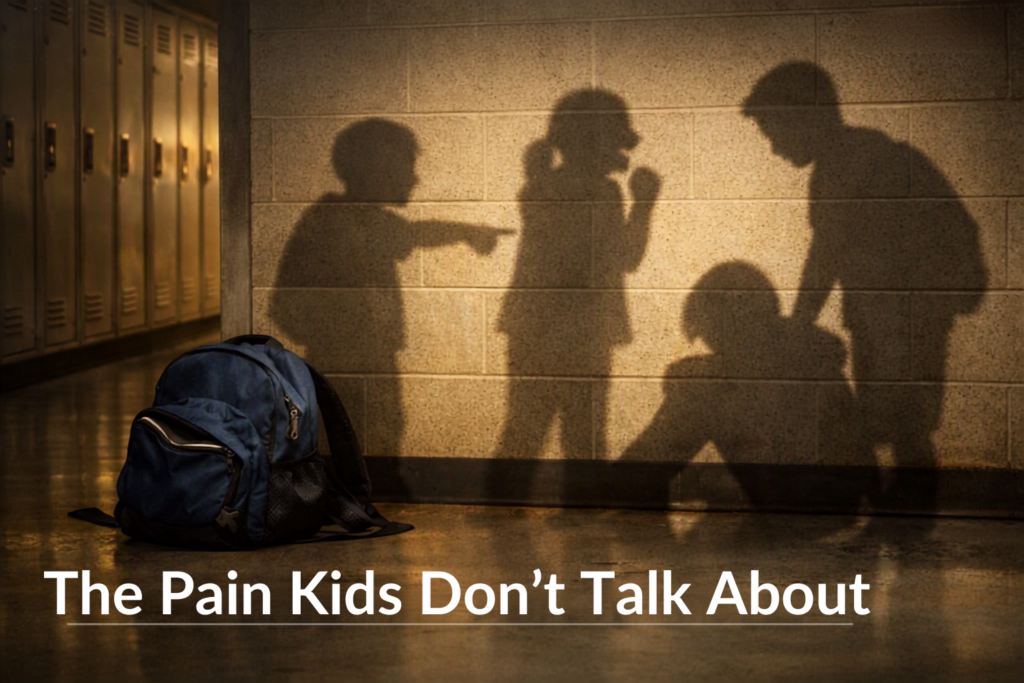
Let me give you a quick snapshot of what younger kids are actually facing. Because the numbers tell a story — and it’s one parents can’t afford to ignore.
- About 24% of elementary school children report being bullied, according to the National Center for Education Statistics.
- Roughly 20% of kindergarteners experience bullying behaviors, including repeated aggression or exclusion, based on the U.S. Department of Education’s Early Childhood Longitudinal Study.
- Physical bullying is more common in younger grades, with elementary‑age kids experiencing higher rates of pushing, hitting, and other physical aggression than older students.
And here’s the part that hits harder: bullying doesn’t just sting in the moment. Research shows that about 23% of bullied children later experience suicidal thoughts, and 31% begin avoiding school, which can derail their emotional and academic growth.
In real‑world terms, this means the hurt doesn’t stay on the playground. A child who feels unsafe can carry that fear into adolescence and adulthood — shaping their confidence, their relationships, and the way they move through the world. Younger kids are still learning how to communicate, how to understand their feelings, how to ask for help. They’re vulnerable. They’re impressionable. And when bullying enters the picture, it can leave marks you don’t always see right away.
Who Gets Targeted for Bullying?
There are kids who get targeted for reasons most parents can spot right away — and then there are kids who get bullied for reasons that aren’t as obvious. Knowing both helps you see the parts of bullying that often fly under the radar.
Obvious Targets
- Kids who belong to a minority group within the school or community.
- Children who are perceived as “different” — appearance, clothing, interests, culture, religion, language, etc.
- Students with disabilities or chronic medical conditions, including weight‑related differences.
- Children who are new to a school and haven’t formed friendships or social protection yet.
Not‑So‑Obvious Targets
- Underweight children, who may be teased for physical differences just as much as overweight children.
- Academically high-achieving or exceptionally talented kids, where jealousy or resentment can make them targets.
- Good-looking kids, especially in middle school and beyond, when social competition ramps up.
- Children with social difficulties — fewer friends, trouble fitting into peer groups, or noticeable awkwardness.
- Anxious, shy, or less assertive kids who appear unlikely to defend themselves (“nice kids,” kids with lower self-esteem).
Bullying doesn’t require a category. Your child doesn’t need to fit any of these groups to be targeted. Sometimes it’s simply about who is nearby when a nonsocialized child decides to exert power. I’ve even seen a bully get bullied — it was strange, but it shows how unpredictable these dynamics can be. And that unpredictability is exactly why parents need to know what signs to look for. The next section goes over the symptoms and behaviors that can help you spot when your child might be experiencing bullying.
Signs and Symptoms That Your Child May Be Being Bullied
Bullying isn’t always loud or obvious. In fact, most kids don’t walk up to a parent and say, “I’m being bullied.” They hide it, minimize it, or don’t have the language to explain what’s happening. That’s why knowing the signs matters. Some are physical, some are emotional, and some show up quietly in a child’s daily behavior.
Below are the most common indicators parents should watch for.
Behavioral Changes
- Sudden changes in school performance — slipping grades, missing assignments, or avoiding participation.
- Not wanting to go to school, asking to stay home, or showing anxiety specifically on school mornings.
- Avoiding certain hallways, classes, activities, or kids they previously enjoyed.
- A noticeable shift in social patterns — fewer friends, isolation, or suddenly being left out.
- Changes in eating or sleeping habits, including trouble falling asleep or nightmares.
Emotional Changes
- Increased irritability, moodiness, or emotional outbursts that seem out of character.
- Appearing anxious, withdrawn, or overly sensitive to criticism.
Physical or Tangible Signs
- Unexplained bruises, scratches, or injuries — especially when the child gives vague or inconsistent explanations.
- Damaged or missing belongings (books, clothing, electronics, lunch money).
- Frequent headaches, stomachaches, or “mystery illnesses” that conveniently appear before school.
Communication & Digital Signs
- Suddenly becoming secretive about their day or refusing to talk about school.
- Saying things like “It’s fine,” “Nothing happened,” or “I don’t want to talk about it,” especially when paired with visible distress.
- Increased clinginess or wanting to stay close to parents more than usual.
- Suddenly deleting social media accounts or asking to change usernames.
What You Can Do as a Parent
Look, I get it. When your child is being hurt, every instinct in your body wants to flip the school upside down until you find the kid responsible. But there’s a difference between what you can do and what you should do — and that distinction matters. Every situation is different. Every child is different. Every parenting style is different. The “right” approach depends on what you and your child are actually dealing with.
I believe every problem has a solution. And as a parent, your job isn’t always to intervene directly — it’s to use your God‑given role to guide, strengthen, and prepare your child.
And before we go any further, let me say this clearly: Confidence, self‑esteem, social skills — all of that could be its own full article. There’s a lot parents can do to build a strong, resilient kid. But the most important thing you can do, above everything else, is be present, be aware, and know when to step in if the situation crosses a line. Your presence and your judgment are the real anchors here.
Build Their Confidence
Confidence can dramatically change how your child is treated. Confident kids signal to others, “I’m capable, I belong here,” and that alone can shift how peers interact with them.
You can build confidence by helping your child practice the kinds of tasks they’ll encounter in everyday school life. Get them comfortable with the basics so they walk into class already knowing a few things.
For example: It’s art time. Your child already knows that mixing red and blue makes purple, while Jimmy thinks everyone gets a cup of water because art makes people thirsty. That tiny bit of knowledge makes your child feel prepared — and preparation builds confidence.
If you want a free printable to help your child learn color combinations, click here for a color printable and click here for a painting printable
Confidence doesn’t have to be academic. Show them how to hit a baseball, dribble a basketball, or play four square. They don’t need to master every activity, but they shouldn’t walk into school not knowing their underwear goes under their pants. Basic competence matters.
Strengthen Their Self‑Esteem
Self‑esteem is different from confidence. Confidence is “I can do this.” Self‑esteem is “I deserve to be here.”
The core idea: self‑esteem comes from your child’s sense of self‑worth.
Ask yourself:
- Does your child believe they can handle themselves?
- Does she know she has every right to exist, play, and participate — and that no kid is “better” than she is?
- Does he understand that he doesn’t have to let others cut in line or push past his boundaries?
Kids need these beliefs ingrained early. When a child carries strong self‑esteem, bullies pick up on it. They think, “He’s not going to be easy to manipulate.”
So how do you build it?
Let them accomplish things. Let them try, fail, try again, and finally succeed. Then praise the effort, not just the outcome. Show them they are capable, strong, and worthy of achieving hard things.
Self‑esteem also shows up in how your child communicates. Kids with strong self‑esteem speak clearly, hold boundaries, and know how to interact without shrinking themselves. Practice social skills with them — how to talk to other kids, how to talk to adults, how to be polite without being a pushover. When a child knows how to use their voice, they walk into situations with more authority, and bullies pick up on that immediately.
Conclusion
At the end of the day, all the skills we just talked about; confidence, self‑esteem, social awareness, resilience, they matter. They shape how your child carries themselves and how others respond to them. But those topics are big enough to deserve their own deep dive, and I’ll cover them in a separate article. For now, the most important thing you can do is stay present, stay aware, and stay connected to your child’s world. Know their patterns, know their personality, and know when something feels off. Bullying thrives in silence, but it loses power the moment a parent notices, steps in, and refuses to let their child face it alone.